
Cancer sequesters and stores seed oils
It's well known that seed oils are industrial waste products rather than real food. I argue that cancer cells try to shield the body from the toxicity of seed oils by sequestering and storing them.

Recap
If you’re new to my blog, we are trying to solve the mystery of how cancer works. Tragically the cancer epidemic appears to be getting worse every year. The fact that modern medicine has failed to solve the cancer epidemic implies (in my opinion) that we need a new theory of cancer.
Recently, I proposed such a new theory, called Toxin Sequestration Theory (TST). It is radical departure from the views of mainstream medicine, to say the least. But it is grounded in solid research from Dr. Stephanie Seneff and Dr. Anthony Kyriakopoulos as well as the clinical expertise of Dr. Garrett Smith.
As a refresher, here are the basic tenets of TST:
Cancer is not a disease. Rather, it is a symptom of toxic overload.
A cancer tumor is not uncontrolled, selfish, malignant growth. Rather, it is tissue created by the body for the purpose of storing and processing toxins. This serves to sequester toxins away from normal tissue, to reduce the exposure of normal tissue to toxins.
Specifically, cancer cells are created to store and process a class of toxins that would generate Reactive Oxygen Species (ROS) in normal cells.
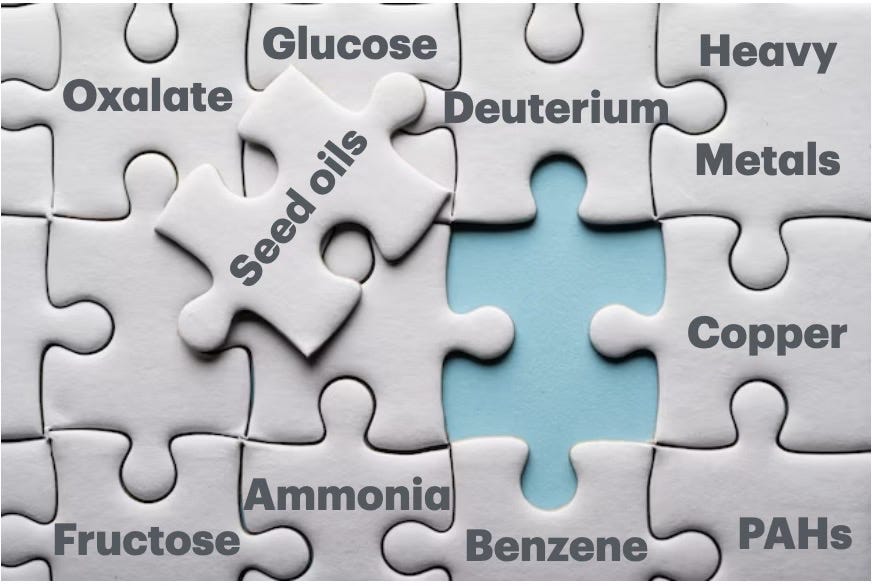
We now have a fairly long list of toxins that cancer tends to sequester. We’ve talked about metals like copper, plant toxins like oxalates, and sugars like glucose and fructose. But one class of chemicals that we haven’t discussed is fats, and the most infamous type of unhealthy fat is seed oils. That will be the topic of this blog!
Seed oils are everywhere
Historically speaking, cotton ginning produced massive amounts of waste cottonseed in the 1800s, and chemists discovered they could process this toxic waste into an edible oil. That’s where seed oils came from - they originated as an industrial waste byproduct.
Nowadays, seed oils are cheap, shelf-stable, and ubiquitous. They’re in fried foods, salad dressings, condiments, margarine, baked goods, granola bars, crackers, chips, and restaurant cooking.
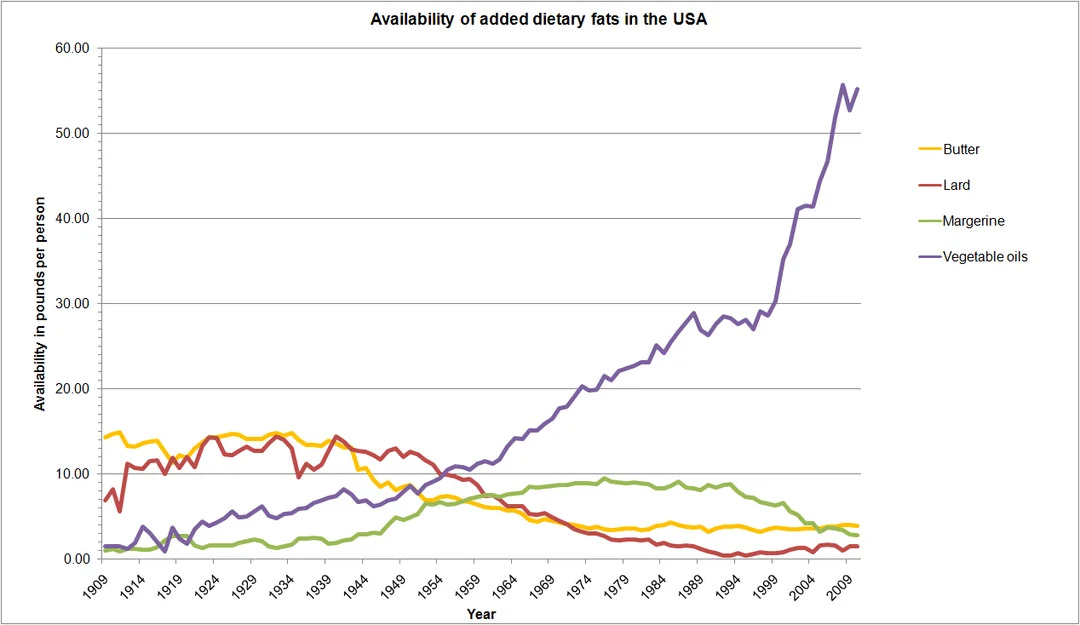
Notice the dramatic historical shift: in the mid-1900s, animal foods still provided 99% of added fats in the American diet. But by the year 2005, 86% of added fats in America came from seed oils. Indeed, the chart below shows the dramatic rise of seed oils (also called vegetable oils) in America, relative to other fats. Of course it’s worth noting that cancer rates in America have also risen over the same time period.
Seed oils contain linoleic acid - a toxin
A key toxic chemical in seed oils is linoleic acid. Linoleic acid is the primary omega-6 polyunsaturated fatty acid (PUFA) found in seed oils, including soybean, corn, sunflower, safflower, cottonseed, grapeseed, and canola oils. Linoleic acid acts as a toxin in chronic excess primarily because it is highly susceptible to lipid peroxidation.
A chain reaction producing massive ROS
In previous blog posts, I’ve talked about how various toxins produce ROS. But lipid peroxidation may just take the cake. It’s a chain reaction! All you need is a single molecule of linoleic acid and a single ROS to get it started.
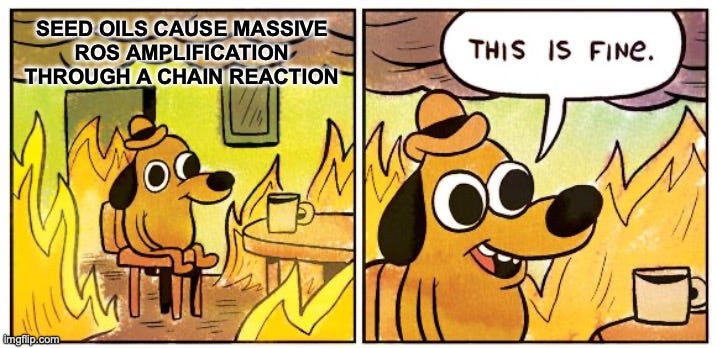
Basically, you just need a single hydroxyl radical (which is a type of ROS) to be already present in the cell, to get the chain reaction started. That radical converts linoleic acid into a lipid radical, which then reacts with oxygen to become a lipid peroxyl radical. That lipid peroxyl radical is considered an ROS, and it continues the chain reaction by converting the next molecule of linoleic acid into an ROS. By the end of the process, the whole population of linoleic acid molecules have been turned into ROS. It’s like a single zombie turning a whole population of people all into zombies.
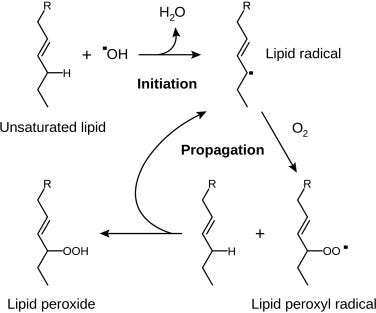
Needless to say, linoleic acid can be classified as an ROS-producing toxin, because of the above chain reaction. Hence, linoleic acid fits perfectly into the paradigm of Toxin Sequestration Theory (TST).
Cancer pulls in linoleic acid
In TST, we would expect the body to create cancer cells to intercept and sequester linoleic acid—the most abundant and peroxidation-prone omega-6 PUFA in seed oils. Thus, cancer cells should play a role in uptaking linoleic acid before it can embed in normal cell membranes and induce a massive ROS-generating peroxidation cascade.
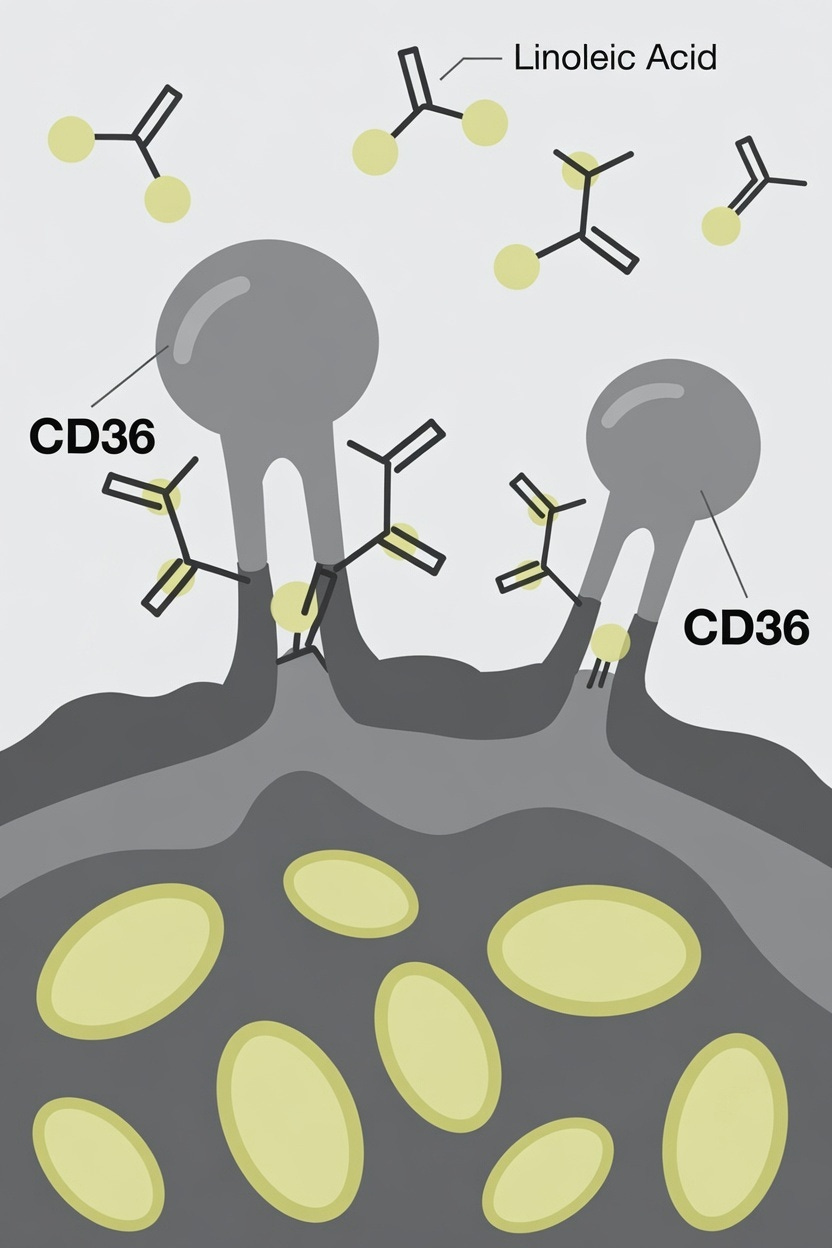
Indeed, we find that cancer cells actively pull in excess linoleic acid. They do this by dramatically upregulating the fatty acid transporters in their cell membrane. The primary mechanism is massive overexpression of CD36 (fatty acid translocase), which has been shown to be significantly elevated in many “aggressive” cancers (breast, prostate, colorectal, ovarian, oral, glioblastoma, and others) compared to normal tissues.
Interestingly, CD36 is a scavenger receptor. Scavenger receptors are the type of transporter often used for transporting “garbage” (like unwanted debris) across the cell membrane. So it’s interesting that the body views linoleic acid as garbage. It’s been shown that CD36 binds to linoleic acid at the cell surface and then pulls it into the cell through caveolar endocytosis.
Cancer stores linoleic acid in lipid droplets
Once cancer cells have pulled in excess linoleic acid via CD36, they store it in cytoplasmic lipid droplets — small, specialized organelles that act as safe, inert storage compartments for unstable PUFAs. As discussed by Dierge et al. (2021), these droplets consist of:
A neutral lipid core (mainly triacylglycerols and cholesteryl esters). This is the hydrophobic interior where fatty acids like linoleic acid are esterified and stored.
A surrounding phospholipid monolayer (with associated proteins like perilipins).
These lipid droplets effectively sequester the highly peroxidizable linoleic acid away from ROS and other peroxidation initiators in the cytosol or membranes. Hence, the lipid droplets are a clever strategy employed to prevent the lipid peroxidation chain reaction from happening.
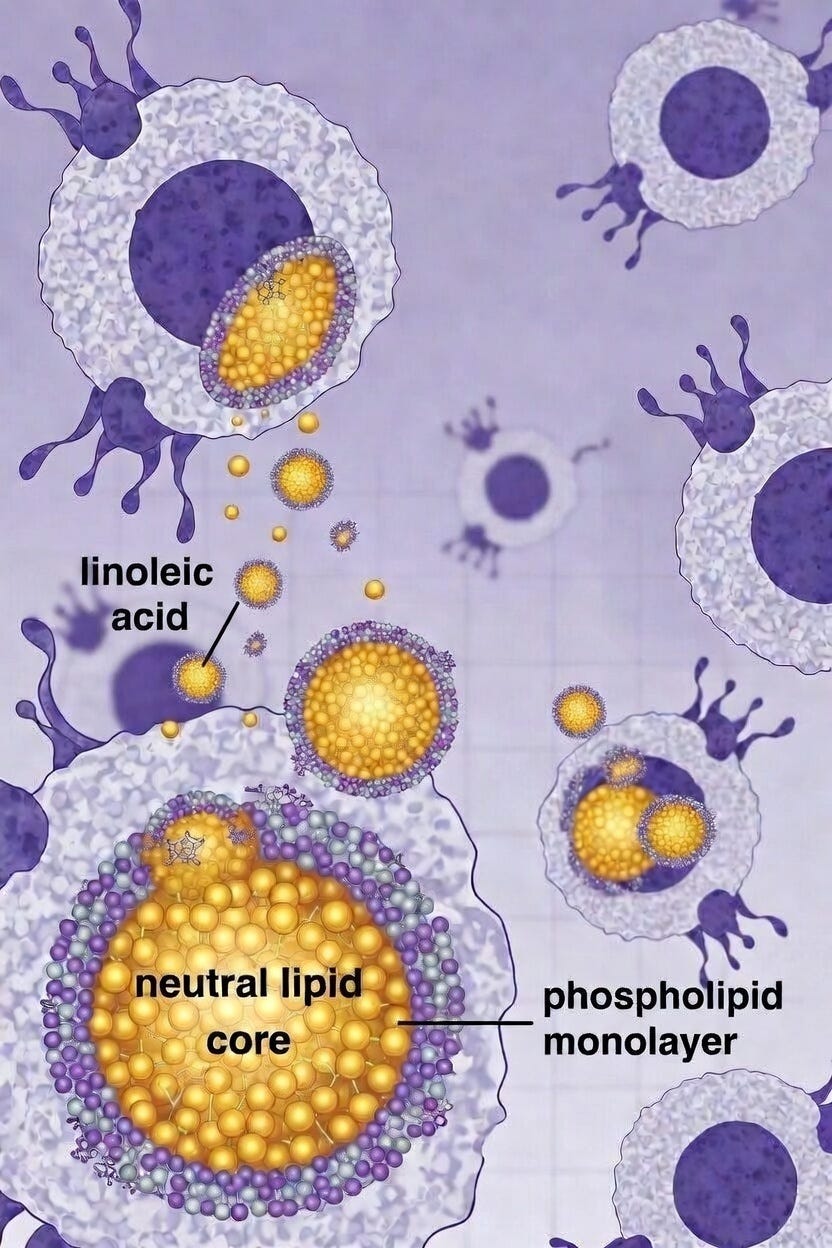
Interestingly, it’s been shown that cancer cells actually upregulate the enzymes that are responsible for lipid droplet biogenesis. These enzymes (called DGATs) catalyze the synthesis of the building blocks needed to make lipid droplets. So it appears that tumors expand their capacity to safely store the very lipids that, in excess, would otherwise create a toxic overload for normal cells.
This is all consistent with studies, like Mika et al. (2020), showing that cancer tissues contained significantly more PUFAs, like linoleic acid, than normal tissues. Lipidomic analyses across multiple cancer types (including colorectal, breast, and prostate) show elevated linoleic acid incorporation into phospholipids and neutral lipids in cancer cells compared to normal counterparts.
Implications for treating cancer
Interestingly, it has been proposed, for example by Feng et al. (2023), that a potential treatment for cancer would be to inhibit the transporter CD36 that pulls linoleic acid into cancer cells. The justification is that cancer cells upregulate CD36, so inhibiting CD36 would selectively target cancer cells.
However, if TST is the correct theory of cancer, then inhibiting CD36 would be a pretty bad idea. After all, it would block the sequestration of linoleic acid. This would allow linoleic acid to roam freely, potentially exposing normal cells to a toxic lipid peroxidation process. This once again highlights why having the right theory of cancer is so important.
Note: this mirrors my previous discussion of how researchers proposed to inhibit the GLUT5 transporter of fructose, which I also believed was a bad idea.
Conclusion
In summary, I argued that:
Seed oils contain linoleic acid, which is a toxin that produces ROS through a massive chain reaction called lipid peroxidation.
Chain reactions are a big deal! It’s rare to find a chain reaction in biology. This suggests that seed oils may be even worse than some other ROS-generating toxins.
Cancer cells upregulate the CD36 transporter in effort to sequester linoleic acid, to protect the rest of the body from its toxic effects.
Once inside cancer cells, linoleic acid is stored for safekeeping in lipid droplets, ensuring that the linoleic acid does not get involved in lipid peroxidation.
All of these points are consistent with TST and align well with this theory.
This blog post gives further motivation to pay close attention to one’s diet. It has been common folklore that seed oils are carcinogenic, and my post certainly supports that view. Elminating seed oils appears to be a crucial step in reducing one’s toxic load. Cooking with animal fats like tallow, lard, or butter - instead of seed oils - would help to mitigate ROS production, and ROS appear to be at the heart of cancer.
Again, very interesting, thanks!